- A New Type of Game Is Emerging
- Why Traditional Blockchains Struggle
- What Makes TON Different
- Telegram as a Distribution Layer
- The Rise of Real-Time Telegram Games
- Infrastructure Requirements for Real-Time Systems
- FomoRush as a Practical Example
- A Shift in How Games Are Built
- What Comes Next
- Final Thought
A New Type of Game Is Emerging
Web3 games are undergoing a structural shift. What started as simple token interactions and NFT-based mechanics is evolving into something far more dynamic — systems that operate in real time, where player actions continuously reshape the environment.
These are not games that you open once and leave. They function as ongoing processes. The state of the game changes every second, and the behavior of one player directly affects others. This creates a shared space where timing, coordination, and reaction speed become core elements of the experience.
However, this type of system places very different demands on infrastructure. Not every blockchain is capable of supporting it.
Why Traditional Blockchains Struggle
Most blockchains were designed with a different use case in mind. Their primary purpose is to securely process transactions and store data. While this works well for financial transfers or occasional interactions, it creates limitations when applied to real-time systems.
In a real-time game environment, delays are not just inconvenient — they break the experience. If a transaction takes too long to confirm, the system becomes desynchronized. If fees are too high, frequent interaction becomes economically unviable. If throughput is limited, the system cannot handle multiple players acting at once.
These constraints make it difficult to build games where the state is constantly evolving.
What Makes TON Different
TON was designed with scalability and speed as core principles, but its real advantage comes from how these technical capabilities are combined with distribution through Telegram.
At the technical level, TON uses a sharded architecture, allowing the network to process transactions in parallel rather than sequentially. This enables high throughput and low latency, which are essential for systems that depend on continuous interaction.
Equally important is the cost structure. Transaction fees on TON are extremely low, which removes friction from frequent user actions. In a real-time game, where users may interact repeatedly within short timeframes, this is not a convenience — it is a requirement.
But the most distinctive feature of TON is its integration with Telegram. This connection transforms it from a blockchain into a distribution layer for applications.
Telegram as a Distribution Layer
Telegram introduces a different model of user access.
Instead of requiring browser extensions, wallet installations, and multiple onboarding steps, users can interact with applications directly inside a familiar interface. Mini Apps and bots allow developers to deliver fully functional products without forcing users to leave the environment they already use daily.
This changes the entry point into Web3.
What used to be a multi-step process becomes immediate. Users can open a game, interact with it, and understand its mechanics within seconds. This simplicity is one of the key reasons why Telegram-based applications, especially games, are scaling rapidly.
The Rise of Real-Time Telegram Games
The combination of TON and Telegram has led to the emergence of a new category of products — lightweight, fast, socially driven games that operate in real time.
These games are fundamentally different from earlier Web3 applications. They are not built around complex interfaces or long-term setup. Instead, they rely on:
- immediate access
- continuous interaction
- shared dynamics between players
This model allows for rapid growth because it aligns with how users already behave inside messaging platforms.
Infrastructure Requirements for Real-Time Systems
To understand why TON is particularly suited for this category, it is useful to compare the requirements of real-time games with the capabilities of blockchain infrastructure.
| Requirement | Why It Matters | TON Capability |
|---|---|---|
| Low latency | Actions must feel immediate to maintain engagement | Near-instant transaction execution |
| High throughput | Multiple users interact simultaneously | Sharded architecture processes transactions in parallel |
| Low fees | Frequent actions must remain economically viable | Minimal transaction costs |
| Seamless UX | Users should not face technical barriers | Native Telegram integration |
| Continuous state updates | The system must evolve in real time | Fast and consistent network performance |
This alignment between requirements and capabilities is what makes real-time mechanics feasible on TON.
FomoRush as a Practical Example
FomoRush demonstrates how these properties can be applied in practice.
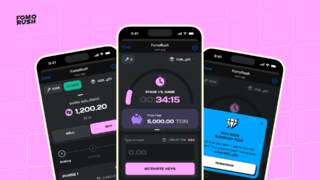
It is structured as a real-time, round-based system where players continuously interact through key activations. Each action extends a live timer, contributes to a shared reward pool, and redistributes value across participants. For more details on FomoRush’s gameplay read that article.
The state of the game is never static. It evolves with every interaction. The outcome is not predetermined but shaped collectively by player behavior.
For such a system to function, the underlying infrastructure must support constant updates, low-cost interactions, and immediate feedback. Without these conditions, the core mechanics would lose their responsiveness.
TON provides the environment in which this type of system can operate smoothly.
A Shift in How Games Are Built
What we are observing is not just a new type of game, but a shift in how digital systems are designed.
The focus is moving away from isolated interactions toward continuous environments. Users are no longer just participants — they are part of an evolving system.
This shift affects both user behavior and product design. Engagement becomes ongoing rather than episodic. Mechanics become dynamic rather than static. The line between game, platform, and financial system begins to blur.
What Comes Next
As infrastructure continues to improve, real-time on-chain systems are likely to expand beyond games.
We can expect to see:
- financial products that react to user behavior in real time
- social systems where value is distributed continuously
- hybrid models combining gameplay, finance, and communication
TON is positioned at the center of this transition because it addresses both the technical and distribution challenges simultaneously.
Final Thought
Real-time on-chain games require more than functionality. They require an environment where interaction feels natural and immediate.
TON provides that environment by combining speed, scalability, and accessibility. When infrastructure becomes invisible, the experience becomes the focus. And in that experience, everything is happening at once — continuously, collectively, and in real time.